Bring Healthcare Projects to Life with Routine Doctor Appointment Illustrations
When you're designing a brochure for a local clinic, building a social media campaign for a health startup, or creating educational materials about patient care, generic stock photos often fall flat. They feel sterile, impersonal, and disconnected from the welcoming atmosphere most healthcare providers want to project. That's precisely where a well-crafted illustration set changes everything. Routine Doctor Appointment Illustrations by NTL Studio offers a comprehensive collection of flat color vector characters and scenes that solve this visual challenge with warmth, clarity, and professional polish.
Understanding the Visual Character of This Illustration Set
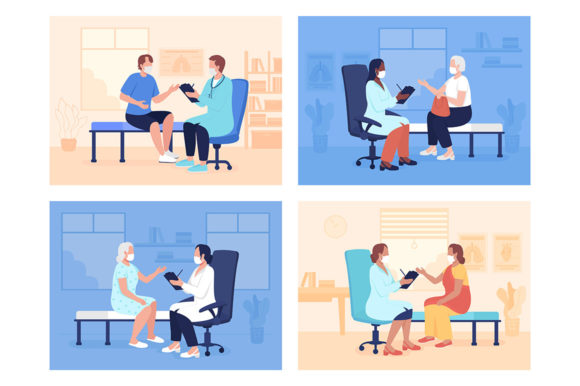
The first thing you'll notice about this collection is its approachable, contemporary aesthetic. The characters are rendered as friendly 2D cartoon figures with clean lines, balanced proportions, and a color palette that feels inviting without being childish. Physicians wear recognizable attire—white coats, stethoscopes, badges—while patients appear in everyday clothing, creating an instant visual shorthand that viewers process immediately. There's no ambiguity about who's who or what's happening in each scene.
The consulting room backgrounds included in the set carry the same flat color treatment. Medical equipment, examination tables, wall charts, and office furniture are simplified into geometric shapes with consistent stroke weights and minimal shading. This style works exceptionally well because it doesn't compete with text overlays or other design elements. Instead, it provides context and atmosphere while keeping the viewer's attention exactly where you want it.
What makes Routine Doctor Appointment Illustrations particularly versatile is the range of interactions depicted. You'll find scenes showing consultations, check-ups, conversations between patients and physicians, waiting room moments, and examination scenarios. Each composition tells a small story, which gives designers tremendous flexibility when selecting imagery that matches specific messaging needs.
Where These Illustrations Deliver Real Value
Healthcare branding demands a careful balance between professionalism and approachability. Hospital systems, private practices, urgent care centers, dental offices, mental health counselors, and telehealth platforms all face the same fundamental challenge: how do you communicate competence while also signaling empathy? These vector characters accomplish both goals naturally. Their friendly expressions and relaxed body language convey warmth, while the clean, consistent art style signals organization and reliability.
For social media graphics, this set is genuinely practical. Instagram posts, Facebook ads, LinkedIn banners, and Pinterest pins all benefit from illustration-based content because it performs well algorithmically and stops the scroll more effectively than text-heavy designs. A single character from the collection, placed against a solid-color background with a brief health tip or appointment reminder, creates an engaging post in minutes rather than hours.
Publishers working on health-related content—whether magazines, newsletters, blog headers, or e-book covers—will find these illustrations add personality without sacrificing credibility. The flat vector style scales beautifully from thumbnail to billboard, so the same asset works for a website favicon and a conference poster. That kind of design asset consistency is hard to overstate in practical terms.
Small business owners in the wellness and healthcare space often lack dedicated design teams. If you're running a physiotherapy practice, a nutrition coaching business, or a pediatric clinic, having access to ready-made banner elements, character poses, and background scenes means you can produce professional-looking materials yourself. The file formats included—JPEG, AI, PNG, EPS, SVG—cover virtually every design tool from Canva and Figma to Adobe Illustrator and Affinity Designer.
Practical Guidance for Working with This Collection
Before incorporating any illustration set into a project, start by evaluating tone alignment. The cartoon style of Routine Doctor Appointment Illustrations leans warm and accessible, which suits patient-facing materials, children's health content, wellness campaigns, and community outreach perfectly. For contexts requiring a more clinical or serious tone—such as pharmaceutical packaging or surgical procedure documentation—a more restrained photographic or technical illustration approach might serve better. Knowing when not to use a resource is just as valuable as knowing when to use it.
Color customization is straightforward with vector formats. If your brand identity uses specific hex codes for skin tones, clothing, or background elements, the AI and SVG files allow direct color adjustments in Illustrator or similar software. This means the illustrations integrate seamlessly into existing brand systems rather than introducing competing palettes. Consider creating a small library of recolored variants so your team maintains consistency across multiple projects and platforms.
Font pairing deserves attention when combining these illustrations with typography. Because the characters have a friendly, informal quality, pairing them with a clean sans serif font for body text and a slightly more expressive display font for headings usually produces balanced compositions. Avoid overly ornate script fonts or heavy serif fonts that might clash with the illustration style's simplicity. A modern typeface with good x-height and open letterforms will complement the visual tone without creating tension.
Test your layouts at actual viewing sizes before finalizing. A character that looks charming at full screen might lose facial detail when reduced to a 200-pixel social media avatar. Similarly, background scenes can become visually noisy if compressed into small spaces. The PNG files with transparent backgrounds are particularly useful here because they let you isolate characters and place them against any surface without awkward cropping or white edges.
Building Consistent Visual Narratives Across Touchpoints
One of the most underappreciated aspects of illustration-based brand identity work is narrative continuity. When a patient sees the same character style on your website hero section, your email newsletter header, your in-office signage, and your appointment reminder postcards, a subtle but powerful sense of coherence builds. The brain registers familiarity, and familiarity breeds trust. Routine Doctor Appointment Illustrations makes this continuity achievable because the entire set shares a unified artistic language—consistent proportions, stroke weights, color saturation, and character design.
For editorial design projects like health magazines or wellness blogs, using multiple scenes from the same collection creates visual rhythm across pages. A consultation scene might introduce an article about choosing a primary care physician, while a waiting room illustration could accompany a piece about reducing appointment anxiety. The stylistic thread connecting these images gives the publication a cohesive identity that readers come to recognize and associate with quality content.
Packaging design for over-the-counter health products, wellness supplements, or first-aid kits can also benefit from this approachable illustration style. Products aimed at families especially respond well to friendly character art on labels and boxes. The flat color reproduction ensures clean printing results across different substrates and production methods, from digital short-run to offset lithography.
Animation creators and motion designers will appreciate the layered structure of the source files. Separating character elements into movable components—arms, heads, facial features—allows for simple frame-by-frame or rigged animations. A physician character nodding during a consultation or a patient raising a hand creates engaging animated content for web design hero sections, app onboarding screens, or video explainers.
Final Thoughts on Getting the Most from This Resource
Every designer accumulates a toolkit over time, and the best resources in that kit are the ones you reach for repeatedly because they solve real problems reliably. Routine Doctor Appointment Illustrations fills a specific niche—healthcare and wellness visual communication—with a style that balances professionalism and personality. Whether you're crafting a full campaign or just need a single character for a presentation slide, having this collection available in your design assets library means you spend less time searching and more time creating.
Take the time to explore all the poses, scenes, and character variations included. Organize them by use case in your own file system—consultation scenes in one folder, waiting room moments in another, individual characters in a third. That small upfront investment in organization pays dividends every time you open a new project and need the right illustration in seconds.